What to Expect on the Day of Your UK Driving Test: A Step-by-Step Guide
Not sure what happens on your UK driving test day? Here's a plain, honest walkthrough of the whole thing so nothing catches you by surprise. Nobody sleeps well the night before their driving test. That's just a fact of life, like Monday mornings or losing one sock in the wash. And weirdly, most of the fear isn't about the driving at all. You've done the driving. You've probably done hundreds of hours of it. What actually rattles people is not knowing how the day itself works. Where do I stand? What do they ask me? When do I find out? Fair questions. Let's answer all of them.

1) Getting There
Ten to fifteen minutes early is the sweet spot. Early enough to use the toilet and get your head straight. Not so early that you're sat in a waiting room for half an hour listening to your own heartbeat.
The one thing you absolutely cannot forget is your provisional licence. No licence, no test, and no refund either. Stick it in your pocket the night before. Check it three times. Check it a fourth time in the car.
If you wear glasses or contacts for driving, obviously bring those too.
2) The Examiner Comes Out
They'll call your name, check who you are, and off you go together to the car. Somewhere in that first minute or two, two small things happen.
One: they'll point at a parked car and ask you to read its number plate. It'll be about 20 metres away. Can't read it? Test over, right there in the car park. Harsh but true, so if road signs have been looking a bit fuzzy lately, sort your eyes out well before test day, not the morning of.
Two: a "Tell Me" question. Stuff like how you'd check the brakes work, or where the washer fluid goes. Your instructor has drilled these into you already. There's a "Show Me" one later while you're actually driving, usually something like washing the windscreen.
A word about examiners, because learners build them up into villains. They're not. They're ordinary people who do this fourteen times a day and would honestly love for you to pass, because passing candidates are pleasant and failing ones sometimes cry in their car. Say good morning. It helps you more than them.
3) The Drive
About 40 minutes, give or take.
You'll cover a mix of roads. Quiet estates, busier main roads, possibly a dual carriageway if the test centre has one nearby. You'll do one reversing manoeuvre out of the possible three, and you won't know which until they ask. Then there's the independent driving bit, roughly 20 minutes of following a sat nav or road signs without turn-by-turn instructions from the examiner.
Forty minutes sounds endless when you're dreading it. Ask anyone who's passed, though, and they'll tell you the same thing: the first five minutes are horrible and the rest is a blur. Your hands know what to do. Let them.
4) About Mistakes
Read this part twice if you have to.
You can make up to fifteen minor faults and still pass. Fifteen! What actually fails you is a serious or dangerous fault, or repeating the same minor mistake over and over until it becomes a habit rather than a slip.
Stalling isn't a fail. A slightly wide turn isn't a fail. Missing a gear change isn't a fail.
What sinks people is the panic afterwards. You stall at the lights, your brain goes into meltdown, and then you rush the next junction and that's where the serious fault happens. The mistake was survivable. The panic wasn't.
Stall? Breathe. Restart. Carry on like nothing happened. For all you know, it was your only minor of the whole test.
Nerves your weak point? We wrote a whole piece on it: How to Handle Driving Test Nerves: Tips from Successful Test Passers. Worth a read the week before.
5) If You Don't Catch an Instruction
Ask them to say it again. That's it. That's the tip.
Asking costs you nothing. Guessing can cost you the test. And a fun fact most learners don't know: taking a wrong turn isn't a fault at all, as long as you take it safely. The examiner will just quietly reroute you. It's the frantic last-second lane swerve to "fix" the wrong turn that gets marked down.
Wrong road, driven calmly, beats right road, driven in a panic. Every time.
6) The Result
You find out immediately, back at the test centre. No envelope, no waiting.
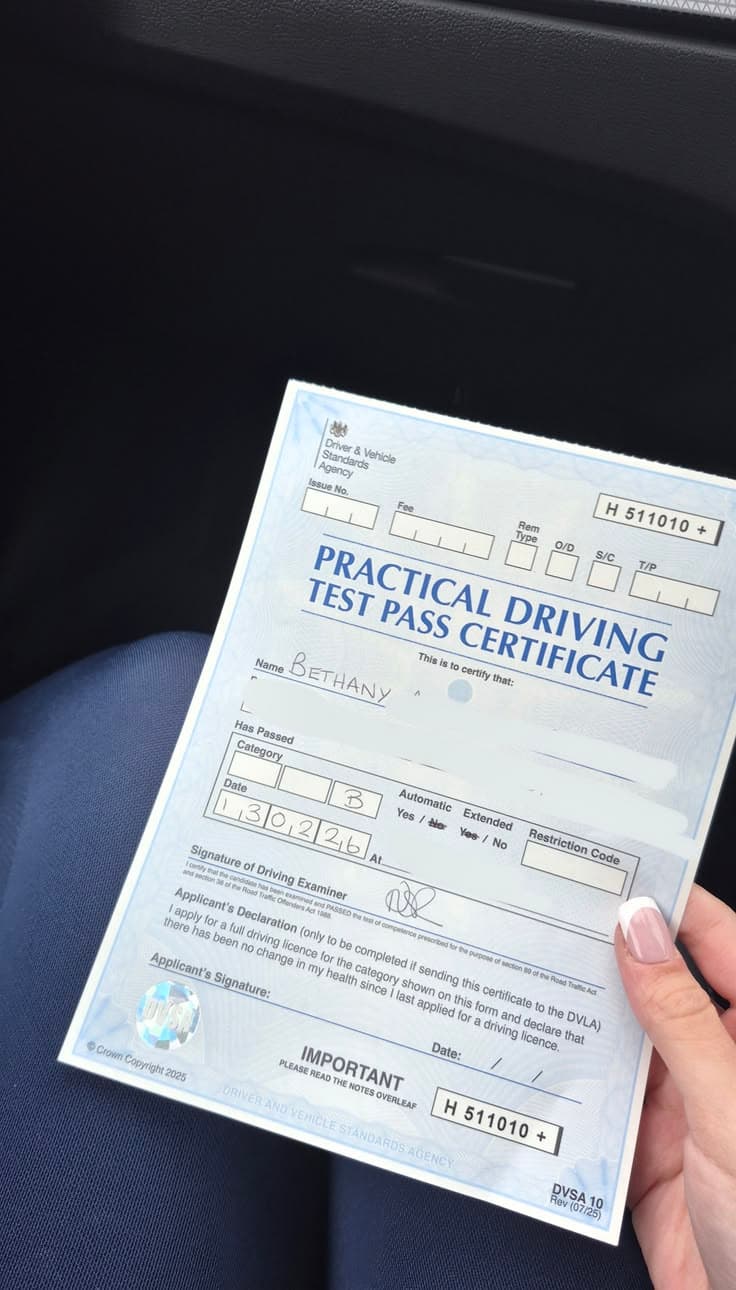
Pass? Lovely. The examiner sorts the paperwork, you can hand over your provisional on the spot and your full licence turns up in the post. Go and celebrate however you like. You've earned it several times over.
Didn't pass? It stings, and anyone who says otherwise has forgotten what it feels like. But make yourself listen to the debrief, because the examiner tells you exactly what went wrong. That list is gold dust. It's a personal training plan for attempt number two. Loads of brilliant drivers needed two or three goes. The test measures one 40-minute window, not your future as a driver.
7) Checklist Before You Leave the House
1) Provisional licence (checked four times, remember)
2) Glasses or contacts if you need them
3) Shoes you can actually feel the pedals through
4) Time to arrive 10–15 minutes early
5) Something in your stomach. Nerves plus no breakfast is a miserable combination
Final Thoughts
The scary part of test day is the mystery, and you've just read the whole mystery. Eyesight check, one question, forty minutes of driving you've done a hundred times before, instant result.
Your examiner wants safe and sensible. Not perfect. Nobody drives perfectly, them included.
Trust the practice. It got you this far for a reason.
🚗 Ready to Find an Earlier Driving Test?
Waiting months for a test date is miserable, especially when you're ready now.
The DriveCircle Browser watches DVSA cancellations for you around the clock, so an earlier slot can land in your lap without you refreshing the booking page every twenty minutes.
👉 Launch the DriveCircle Browser and start hunting for an earlier test date today.